global journeys: belize
A BLOG DOCUMENTING A WEEK SPENT LEARNING INDIGENOUS CONSIDERATIONS OF HISTORY AND IDENTITY IN BELIZE
Out of all the programs offered at Agnes Scott College, Global Journeys has to be the most acclaimed: when students talk about what attracted them to Agnes Scott, many mention the focus on opportunities for global learning at the institution. The Journeys course kickstarts the idea of global learning providing first-year students with a course during their second semester centred around a specific location and a topic related to the area’s history and cultural makeup. The apex of the class, many would say, is the week spent in the country or city they had learned about, immersing themselves in the topic at hand. In one of the two Belize immersions this year, we focused entirely on post-colonialism and how a sense of identity is fostered in a country battling imperialistic ideals. Pre-visit we discussed at large the effects of British colonialism in Belize with the aid of several readings, particularly The Last Flight of the Scarlet Macaw by Bruce Barcott, a book focused on the impact of the Western world in Belize post-independence in relation to the implementation of a dam that would damage the scarlet macaw population. Throughout the semester, I was always brought back to one of the lines that struck me in the beginning of the book: “you couldn't speak of the place without acknowledging its foreign ownership” (Barcott). Before heading off to Belize, I thought I didn’t have much to take with me there — I expected and wanted to experience everything freshly — but I think it was the one thing I kept subconsciously mulling over in all our activities and conversations.
ENTRIES BY JANAE A. RABESS
IMMERSION
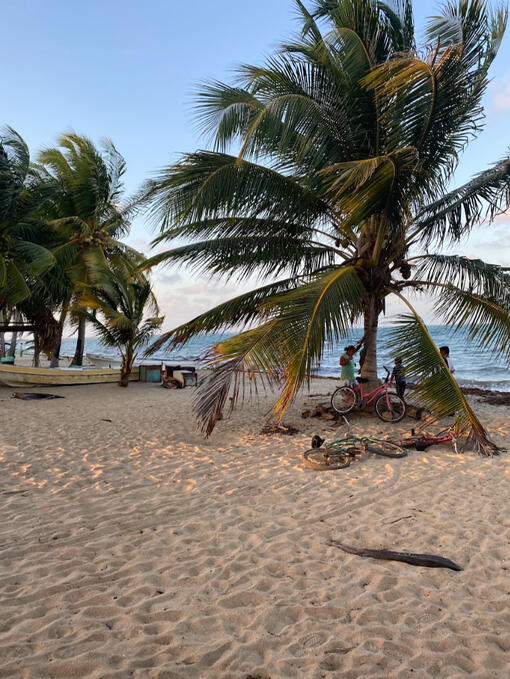
Throughout our section’s time together in Belize, I kept looking out for markers of Belizean identity. As the week came to a close, minimising my understanding became decisively harder as our interactions and acquaintanceships broadened. We began our week in Hopkins, Belize at an eco-cultural institute run by a local Garifuna family called Palmento Grove. In the one day we spent at Palmento Grove, we were led through a series of traditional Garifuna practices. We started with a history of the Garifuna: their Afro-Caribbean heritage, the creation and structure of the language they use and their spiritual practices. Uwahnie, who led most of the experience, spoke on how preserving their history and culture has become especially important for them as they navigate oppression from various sources. She provided the example of not being able to speak the Garifuna language at her previous job, which partially influenced her decision to create a space where Garifuna culture could be celebrated and used to educate others on an integral part of Belizean history. We later took a tour of the grounds learning about the healing properties and health benefits of different plants and herbs that grew there, followed by our participation in making hudut, a traditional Garifuna dish of plantains, fish and coconut milk. The day closed with our group participating in a drumming lesson, learning the different meanings behind beat patterns and how the music they create has also become a way of celebrating their language.
Still in Hopkins, my group from Agnes Scott took a tour of the Garifuna Cassava Farm, learning the family history of the site – the use of technology their family invented to hasten the manufacturing of cassava products, stepping away from traditional practices. Still, they walked us through both processes, allowing us to experience the grating of peeled cassava roots on a long wooden board layered with pebbles called an egi before letting the machines do the work. From digging up and harvesting the cassava to peeling, washing and grating them to juicing the root and sifting the dried remains, we participated wholly in the experience and were also given the option to finish the process using the cast iron comal laid above a fire.
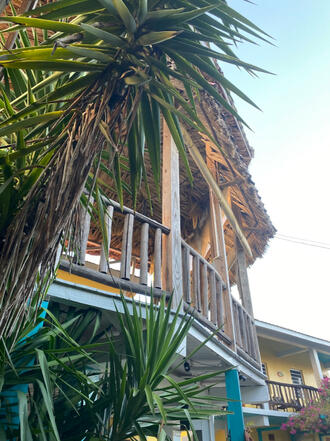
Where we had more extensive expeditions the first two days, everything as the week continued became briefer for the purpose of getting to various locations, but never lost value. On Wednesday, our group had the opportunity to present with students from Galen University in San Ignacio. This opportunity to interact and collaborate with other university students was, I believe, unique to our Journeys trip and in working asynchronously with them over the course of the semester, we gained further insight into local opinions on tourism and identity in relation to the students’ personal environments. Due to our peers at Galen’s participation in an Environmental Science course, we were tasked with presenting on an environmental issue prevalent in Belize that could be related back to the United States. My group discussed deforestation, using the Amazon Forest as a model, and relating it back to cases of regulation implemented to prevent deforestation in Belize such as the National Parks Systems and Environmental Protection Acts. In contrast, we briefed our audience on the Cop City movement happening currently in Atlanta, Georgia aiming to protect over 80 acres of the South River Forest (alternatively known as ‘the lungs of Atlanta’ and indigenously as the Weelaunee) from being cut down to accommodate a large police and fire services training facility. Within this same day, we were able to visit the Belize Zoo and Tropical Education Center on a night tour, learning about the efforts done to save animals native to Belize from life threatening situations and to provide them with a chance at living as normally as they can away from the wild, where they might not have been able to having been the runts of their litter or kept as domesticated pets. Having the animals be native to the area allows Belizeans to view animals within their home country they might not have otherwise seen and fosters a sense of appreciation and desire to protect their environments.
Our fourth day in Belize was by far the busiest, with an initial conversation about the preservation of natural landscapes and a visit to St. Herman's Blue Hole National Park followed by a stop at the Belmopan Market. At the market, local vendors sold fresh meals and vegetation that are core to the lifestyle of Belizeans such as fried jacks, panades, and rice and beans, allowing money to circulate throughout the community and support each other. The day ended back in San Ignacio, where our group attended a traditional chocolate making workshop where we learnt the historical Mayan relationship with cacao or, to the Maya, ka’kau. The plant was often considered the ‘food of the gods’ by Mayan civilizations as it became one of the staples in their diets and eventually took monetary status. We were guided through their method of grinding cacao nibs and simultaneously told about how significantly Western industries have changed how chocolate is thought of globally with additives such as milk and sugar that the Maya originally never used and how damaging this can be to the cultural practices of the Maya who have to gradually adhere to the demands of the industry to profit.
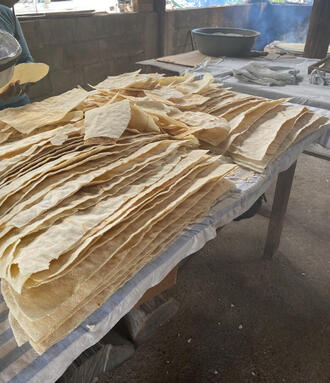
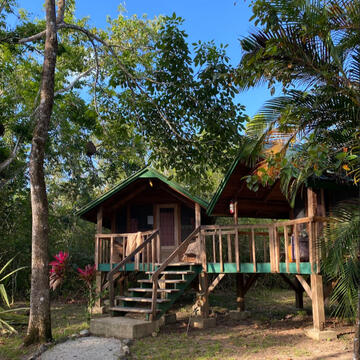
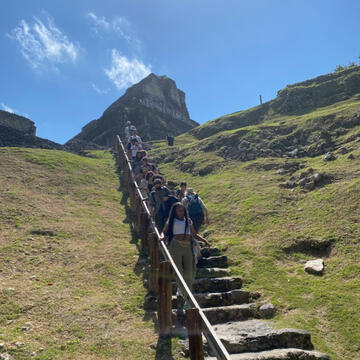
At the Xunantunich Mayan Ruins on our final day in Belize, we toured the ruins with the guides discussing the significance of the monuments geographically, religiously and culturally. They taught us of the provisions made for the purpose of satisfying their gods from making the steps to their buildings taller to accommodate for the gods’ future arrival to making human sacrifices. Our guides explained that the evolution of sacrifices from domesticated animals and crops to human sacrifices came from the belief that the gods were punishing them through giving them less rain, and that the sacrifices themselves transitioned from slaves (considered at the bottom of the socioeconomic pyramid) to royals (held a certain power and aristocracy that may satisfy the gods) to children (deemed the purest souls). Despite knowing much of their history, the guides acknowledged that due to colonisation, the Maya lost much of the documentation of their customs and research linked to geography and astronomy. After leaving the site of the ruins, we attended a traditional Mayan cooking class, where we handmade tortillas and got to interact with the Mayan women there, which displayed once again to us how meals, similarly to almost everything else, are a community or group effort in Belize.
CROSSROADS
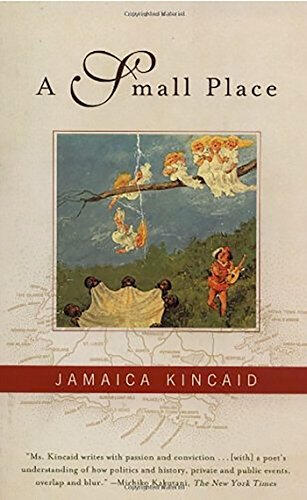
In order to place my thoughts about our journey to Belize, I thought back to our previous discussions and readings in the course and, of course, came back to Jamaica Kincaid’s A Small Place. I was questioning a lot about the concept of identity and what makes identity a singular and whole thing, and came back to the consideration, “what is culture, anyway?” (Kincaid). It is a line I have been mulling over for months now, knowing exactly what Kincaid meant, and still, wishing I could dig deeper into it. Kincaid spends her entire book talking about the nature of Antiguans and particular traits they share only to finally insinuate that Antigua is one of the countries that “have no culture or afraid they have no culture” and ultimately, do not have anything shared that they can call theirs (Kincaid). And whilst I agree with the thought that the word culture has been diminished into nothin and almost made futile in meaning, I think my experience in Belize served to challenge Kincaid’s narrative. Where she states that “the people in a small place cannot see themselves in a larger picture, they cannot see that they might be part of a chain of something, anything”, everything done in Belize pointed to the opposite of that (Kincaid). The destruction and suppression of history that Belizeans have faced reflects on their very intentional efforts to fight against colonialistic ideals. The people we interacted with in Belize showed that they were actively thinking of their country as their home and as a place they have to safeguard after all attempts to uproot their history with attempts to preserve practices like at Palmento Grove and the cassava farm, protect wildlife as the Belize Zoo and Tropical Education Center does, and educate others on the foundations of their country like all the significantly Mayan sites we visited did. By reclaiming what they could and stepping away from Western expectations, the people of Belize showcase what culture and identity can be: a thoughtful, collective reconsideration of the past and intentional installation of thoughtfulness and care for one’s country in the present.
HOMECOMING
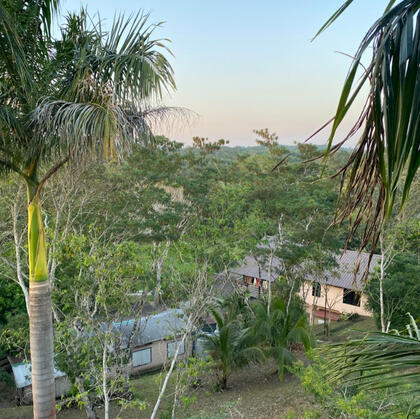
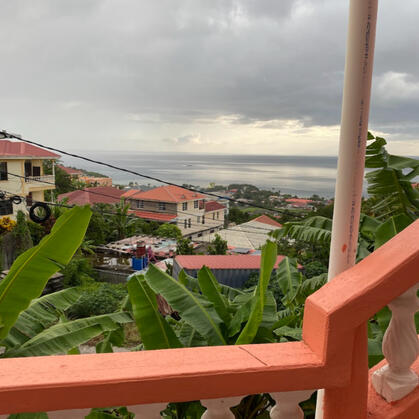
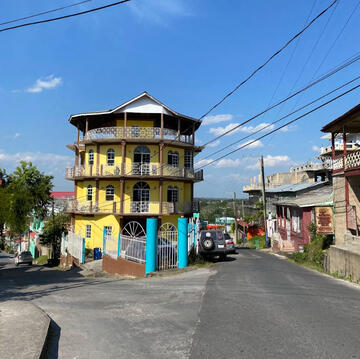
My experience in Belize allowed me to reflect a lot on my own upbringing and heritage, and within the week I spent there with my peers, I felt more validated in my feelings regarding my home country than I had in a long time. Before coming to Agnes Scott College and attending boarding school in Sewanee, Tennessee before that, I was raised in Dominica, a small country in the chain of Windward Islands in the Caribbean. My father is of Kalinago heritage, and though the population is relatively small, Dominica possesses one of the largest remaining indigenous populations in the Lesser Antilles. In Belize, when discussing the Garifuna language, I learned that Arawakan and Kalinago languages were used to form the structure of theirs. The revelation shocked me as I had spent the past night hearing nearly everyone in Hopkins use this language to communicate whereas in Dominica, I had never heard anyone speak in our native language. Of course, certain phrases and words stuck after years of colonization and genocide, but I had not even known that that people still spoke any of these tongues witch such fluency or that it was being utilized in any way today. I felt like I had gotten the short end of the stick. My consideration of the loss of history was consistent throughout the trip and heightened by the Maya talking about how their own incredibly rich history was torn away from them. But, still, somehow, I was able to remain immensely grateful for my opportunity to be in Belize and to remain hopeful in some sense. At the Mayan chocolate making workshop, we were told that some of the youth in the area haven’t been outside a 15 mile radius of their homes and it really made me consider the privilege of being able to go to another country just to learn and not just about other people, but myself as well. I always felt like I was back in Dominica during our stay in Belize, with little things in our everyday expeditions sparking a peculiar homesickness I had never felt before within me. Hearing the drums played by the Garifuna, making our meals in a group setting, harvesting cassava and making bread, seeing the Japanese imported cars and brightly painted houses. I knew that these were things I grew up with and wanted to take with me wherever I went and that there is still so much to learn about my background and in a region as tightly woven as the Caribbean, I should not have been surprised to find such large parts of myself in another country. I want to thank Belize for teaching me the power of intentionality and giving me a newfound appreciation and love to take back home with me.